Stop guessing. Find your $10K MRR SaaS idea today.
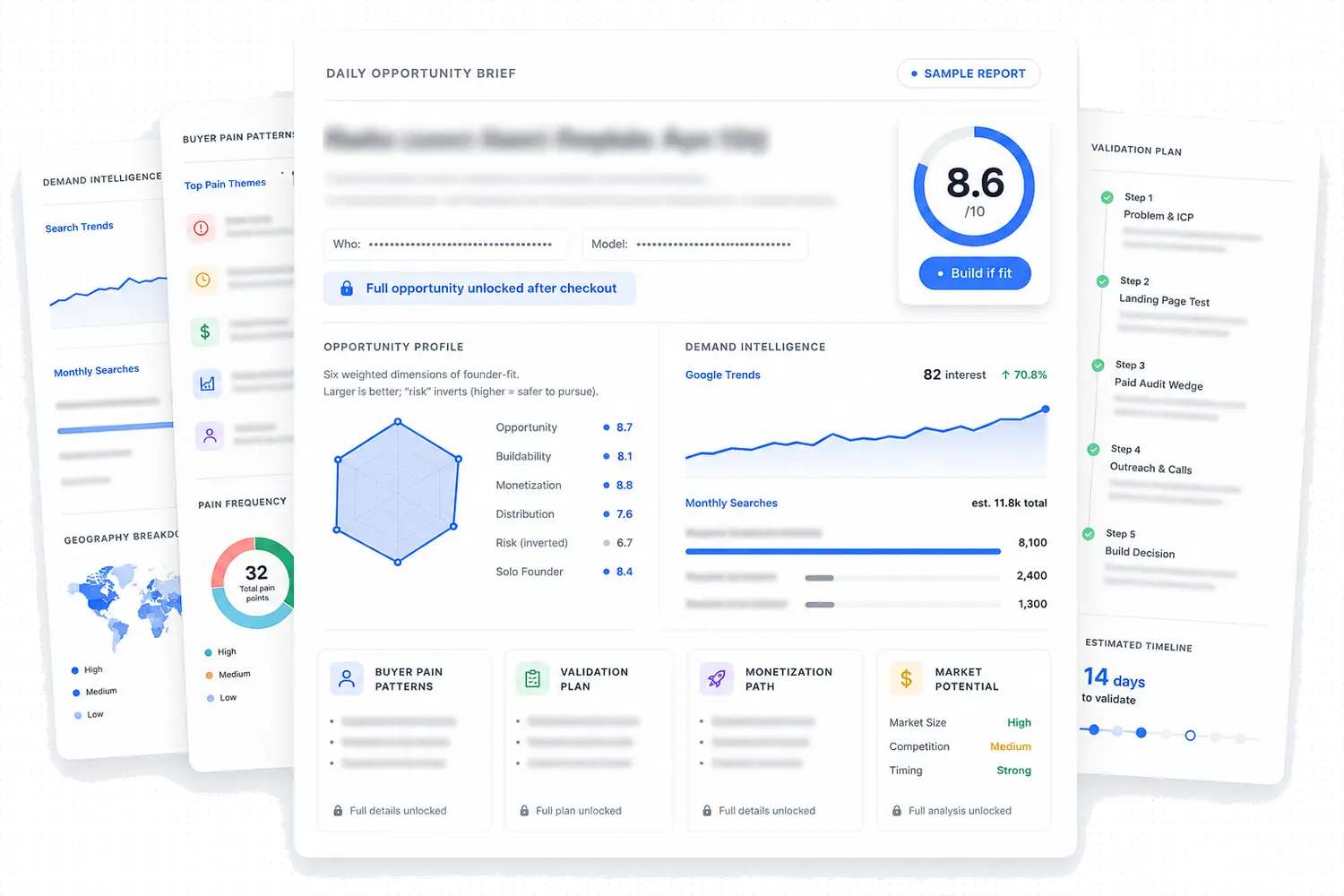
You get validated SaaS ideas delivered daily with demand signals, customer pain points, monetization paths, and validation steps.
So you can decide what to build without spending hours hunting from scratch.
Category · Buyer segment
8.2/10
DemandStrong
Buyer PainHigh
BuildabilityHigh
RiskMedium
Google Trends 82 interest · ↑ 71%
Monthly searches est. 11.8k total
“sample keyword cluster one” 8,100
“sample keyword cluster two” 2,400
“sample keyword cluster three” 1,300
How it works
Three steps. Every day.
No blank page. No guessing. Just a researched opportunity and a clear next step.
1
Get one researched idea
A new software opportunity lands every day, with the customer, pain, and demand already mapped.
2
Review the proof
See the demand signals, competitors, money model, and risks before you commit any time.
3
Run the first test
Start with the smallest version and the validation plan, so you build only what’s worth building.
The problemBuilding is fast now.
Building is fast now.
Picking the right idea is still hard.
You can build a landing page or MVP faster than ever. But the big question stays the same: will anyone pay for it?
Most builders don’t fail because they can’t build. They fail because they pick something with no clear customer, no real pain, and no way to get users.
The risk isn’t building too slow. It’s building the wrong thing fast. Daily brief gives you a researched idea, not a blank page.
The AI builder trap Today’s reality
Build speed has exploded. Confidence that anyone will pay has not.
The gap = wasted weeks Everything between fast and known is risk.
Fastto build now
Hardto validate
Costlyto guess wrong
Will anyone actually pay?See if people already spend money, search for help, complain about it, or use messy workarounds.
Can I reach them?Know the first place to find them before you build.
Can I test it simply?Start small with a simple tool, a template, or a manual step, before you build the full thing.
For builders who can build
You Can Build. But You Don’t Know What to Build.
If you use AI tools, shipping is no longer the hard part. The hard part is picking something worth shipping.
Confidence per dimension 0–100
Just an idea Researched brief
Customer clarity
Pain & demand proof
Reach path
Money model
First test clarity
“I want to build a SaaS, but I don’t know what to pick.”
Start with a researched idea, not a blank page.
“I can build it, but I don’t know if anyone will pay.”
Each brief shows the customer, the pain, and signs people may pay.
“I keep saving ideas, but none feel real.”
A list isn’t a real customer with a real pain and a plan.
“I want recurring revenue, but I don’t know where to start.”
Start with one customer, one problem, and a clear way to make money.
“I need a simple idea I can test on the side.”
Each brief gives you the simplest first version to test.
“I don’t want to waste weeks on the wrong thing.”
Know who wants it, why they’d pay, and what could fail.
“I need to know how I’d get customers.”
Each brief comes with a launch path to find early users.
“I want to know what could make this fail.”
See the risks before you spend weeks going the wrong way.
Each brief starts with the customer, pain, demand, and first test. Not just the idea.
The new bottleneckOld question: Can I build this?
Old question: Can I build this?
New question: Should I build this?
AI helps you code, design, and ship faster. But it can’t tell you which customer to serve, what problem is worth solving, or how to get your first users.
That’s what each brief answers. Before you build, know:
- Who the customer is
- Why the problem matters
- If there are signs of demand
- What people use now
- How it could make money
- What the first version should include
- Where to find early users
- What could make it fail
Old question “Can I build this?”
New question “Should I build this?”
Old question Can I build this?
Code and design used to be the hard part.
New question Should I build this?
Now the hard part is demand, reach, and picking a problem worth solving.
Speed helps you build. Direction helps you build the right thing.
Less hunting. More building.
$3K MRR is not tiny if the tool is sellable.
A focused SaaS doing $3,000 in monthly recurring revenue can become a real asset, even if it never turns into a venture-scale company.
At a 10 to 20 times MRR multiple, that kind of tool can imply roughly $30,000 to $60,000 in exit value. The point is not to hunt forever for a perfect idea. It is to find a validated problem, build the simplest paid version, and start compounding.
Example asset math
$3K monthly recurring revenue
10-20x example small-SaaS MRR multiple
$30K-$60K estimated exit value
Not a guarantee. A reason to stop treating small SaaS ideas like lottery tickets and start treating validated problems like buildable assets.
Less hunting Skip the blank-page search for a random idea.
More building Start from a validated SaaS brief and test the offer faster.
Core promise
Start with demand, not a random idea.
A good idea answers more than “Can I build this?”
Each brief answers the questions that matter before you build:
1Customer
2Pain
3Demand
4Reach
5Money
6Risk
Test-ready
Who wants this?The exact buyer to test first.
What pain do they have?The wasted time, lost money, or urgent need behind it.
Are people searching for help?Search interest and complaints that show people care.
Are they already spending?Tools, agencies, or workarounds people pay for now.
What do they use now?The tools or manual workarounds they rely on today.
Can you reach them?The first place to find them: a group, site, or search term.
What’s the smallest version?The simplest first version to test before the full product.
Why might they pay?Time saved, money made, or a need they feel now.
What could make it fail?The risks and weak points before you build too much.
Research methodology
How each idea is researched.
Every brief is built from public signals and real market evidence, not guesswork. Here’s what goes into each one.
Demand signals
Search trends, keyword volume, complaints, and signs people already spend money on the problem.
Market context
Existing alternatives, competitors, paid workarounds, and gaps in what’s available today.
Buyer clarity
Who has the pain, why it matters to them, and where you can find them to test first.
First test
The smallest version to build, the validation path, and clear kill criteria before you overcommit.
Signals are directional. You still need to validate, build, and sell. The brief gives you a strong head start.
Inside each brief
Everything you need before you build.
Each brief shows the idea, customer, pain, demand, first version, how to reach them, how it makes money, the risks, and what to test first.
The goal is simple: help you decide if the idea is worth your time.
Daily brief · anatomy Researched
What every brief includes
One page. Every answer that matters, before you spend weeks building.
The ideaWhat to build and what the first version does.
The customerWho to start with and why they’d pay.
Demand signalsSearches, complaints, and signs people spend.
First versionThe smallest thing to test first.
Launch pathWhere to find your first customers.
Risks & scoreWhat could fail, with a clear opportunity score.
Opportunity score 8.6
Idea
The idea
A concrete product angle, who it helps, and the smallest useful version to test.
Customer
The customer
The first buyer segment, where to find them, and why the problem matters now.
Pain
The pain
The costly, annoying, or urgent problem that gives the idea a reason to exist.
Demand
Demand signals
Search terms, complaints, paid alternatives, and workarounds that show people already care.
Alternatives
What people use now
Current tools, spreadsheets, services, or manual processes the product would replace.
First version
First version
The smallest build scope that can prove demand before you overbuild.
Reach
Launch path
The first channel, community, or search path to reach likely buyers.
Money
How it makes money
Likely pricing models, buyer willingness, and simple packaging angles.
Risks
Risks
The assumptions most likely to break, plus what to validate early.
Score
Opportunity score
A quick read on demand, pain, buildability, monetization, and risk.
Test
Validation plan
A practical first test to confirm the buyer, problem, and offer.
Language
Customer words
Real phrases customers use so positioning and outreach start sharper.
Example brief
What a researched idea looks like.
A good idea shouldn’t just sound exciting.
It should show the customer, pain, proof, first version, how to reach them, how it makes money, and what could go wrong.
Refund-Loss Detective for Shopify Brands
A focused tool that helps Shopify brands find which products, ads, promises, reviews, support issues, or fulfillment problems are causing avoidable refunds and margin loss.
Who: Shopify brands losing margin to refunds Model: Paid audit → monitoring subscription
8.6Final · /10
Build if fitOpportunity8.7
Buildability8.1
Monetization8.8
Final8.6/10
Best: Monetization8.8/10
Watch: Sales difficulty6.7/10
Confidence7.8/10
At a glance
Opportunity profile
Six weighted dimensions of founder-fit. Larger is better; “risk” inverts (higher = safer to pursue).
Opportunity8.7
Buildability8.1
Monetization8.8
Distribution7.6
Risk6.7
Solo Founder8.4
🔍 Demand intelligence
Search-interest trend and estimated keyword demand for “sample keyword cluster”
Latest: 82/100 ↑ +70.8% Geo: US Monthly searches: 11,800
Google Trends relative interest Normalized 0–100, last 12 months
Google Ads keyword demand Estimated average monthly searches
“sample keyword one”8,100
“sample keyword two”2,400
“sample keyword three”1,300
“sample keyword four”720
Google Trends shows normalized 0–100 relative interest, not exact monthly search volume. Google Ads figures are estimated average monthly searches and are directional. Past 12 months.
What it is
A narrow tool built for a specific buyer and a repeatable workflow.
Who
A reachable buyer segment with visible urgency and willingness to pay.
The pain
A recurring problem currently handled with manual workarounds.
Why now
Demand signals and lower build costs make the first version easier to test.
Proof
Evidence Signals
Source-backed signals behind the opportunity, separated from the narrative so the proof is easy to scan.
Strong
3
Solid
4
Moderate
1
Paid alternatives Buyers already pay around this problem
Adjacent tools and services exist, but none solve the exact workflow this opportunity targets.
Pain signal Repeated complaints are visible
The same frustrations show up across reviews, forums, support tickets, and community discussions.
Willingness to pay The problem has a clear money cost
A product that prevents one costly mistake per quarter pays for itself at any reasonable price.
Market map
Competitor And Workaround Matrix
The alternatives buyers already use, where they are strong, and the gap a focused product can exploit.
Alternative
Strength
Weakness
Gap to exploit
Adjacent tool A
Solves part of the workflow
Doesn’t solve the core problem
Focus on the exact unmet need
Adjacent tool B
Already adopted by buyers
Manual and time-consuming
Automate the repetitive step
Adjacent tool C
Collects useful data
Doesn’t turn it into actions
Convert data into ranked actions
Generic workaround
Familiar and free
No tracking or accountability
Provide a dedicated, reliable record
Scoring
Score Rationale
Dimension-level reasoning behind the recommendation, grouped by category.
Demand signal8.7
Strong search interest in the category and a rising trend in related queries.
Customer pain9.1
The problem directly costs the buyer time or money, but they can’t solve it without manual effort.
Buildability8.1
The MVP is a focused workflow from standard data inputs. No heavy integrations needed first.
Monetization8.8
A paid first offer leads into a recurring subscription. Clear path from one-time to ongoing.
Distribution7.6
Founder-led outreach to the buyer segment. Reachable via communities and directories.
Risk6.7
Fails if each instance needs too much custom work, or if buyers treat the problem as unavoidable.
Decision
Final Verdict
Build if fitThis idea has a clear buyer, a painful recurring problem, and a simple first step.
Don’t build the full product first. Try to sell a paid first offer, then build the recurring software if buyers ask for ongoing help.
This is a public sample. Member reports include the full source review, scoring rationale, competitor context, and validation plan inside the private archive.
Why this is different
Not random ideas. Researched opportunities.
Random idea lists are easy to find. The hard part is knowing which ideas have a real customer, visible pain, signs of demand, and a clear next step.
Just an idea
- Vague customer
- No proof of demand
- No launch path
- No first test
- No risks listed
- Sounds nice, but “so what?”
A researched opportunity
- Clear customer to start with
- Visible pain they already feel
- Demand signals and searches
- The simplest first version
- A launch path to early users
- Risks and what could fail
That’s the difference between another idea and an opportunity worth your time.
Opportunity categories
Not just B2B SaaS ideas.
The best idea isn’t always a B2B SaaS app. Each brief can cover many kinds of software, as long as it’s simple to start and can make money.
Micro-SaaS
Small tools for one clear job.
AI tools
Simple AI tools with a clear use.
Shopify apps
Tools for online stores and sellers.
Creator tools
Software for creators and community owners.
Chrome extensions
Small tools that live in the browser.
Prosumer tools
Tools people pay for to work better.
Simple B2C apps
Apps for regular people, with paid features.
Platform add-ons
Tools for Shopify, Notion, Chrome, or Slack.
Vertical software
Tools for one industry or role.
Niche workflow tools
Small tools for one repeated workflow.
Paid templates & utilities
Templates that can grow into software.
Automation tools
Software that removes repeated manual work.
The rule: Can one person test it? Is there real pain or demand? Can you reach them? Can it make money?
Built for fast builders
For fast builders who want better direction.
Daily brief is for people who can move fast but don’t want to waste time picking ideas from a blank page. It helps if you can build, but want more confidence about demand, customers, and money first.
A fit if you’re…
- An AI builder, developer, or solo founder
- An indie hacker or technical founder
- A vibe coder or no-code builder
- A creator looking for a software product
- Using Cursor, Codex, Claude Code, Replit, Lovable, Bolt, or v0
- Looking for a clear customer and first version
- Wanting more confidence before you build
Not a fit if you want…
- Guaranteed revenue
- Passive income with no work
- A promise every idea will work
- Huge enterprise ideas needing a big team
- Random ideas with no customer or proof
- Someone else to build it all for you
After you join
What happens next.
No onboarding calls. No setup. You get immediate access to today’s brief and the full archive.
1
Get instant access
Checkout unlocks the subscription. Read today’s brief right away.
2
Read today’s brief
Review the customer, demand, score, risks, and first test before you decide to build.
3
Browse the archive
Explore every prior brief whenever you’re ready. Pick what fits your skills and start building.
Simple pricing
One good idea can save you weeks.
For $1 for your first 30 days, then $39/month, get one researched software idea every day. See the customer, pain, demand, first version, launch path, money ideas, risks, score, and first test.
Daily brief
One researched idea every day.
For builders and solo founders who want simple software ideas with demand, customers, and a way to make money.
- One new brief each day
- Customer profile
- Pain and demand signals
- Competitors and alternatives
- Simple first version
- Launch path
- Money ideas and price ranges
- Risks and kill criteria
- Opportunity score
- Validation plan
- Private archive of briefs
- Cancel anytime
No idea is guaranteed. You still need to test, build, and sell.
Cancel anytime. No long-term commitment.
Subscription $1 for your first 30 days
Then $39/month for a researched idea pipeline.
Daily brief Archive access Validation plan Cancel anytime
Find Your Next SaaS IdeaSecure checkout. Cancel anytime.
No long-term commitment.
Subscription
Start small. Keep it only if it helps.
Join today for $1 for your first 30 days.
After that, your subscription continues at $39/month unless you cancel. No long-term commitment.
FAQ
Questions before you join.
Is this just a list of ideas?
No. Each brief includes the idea, customer, pain, demand, first version, launch path, money ideas, risks, and first test. The goal is to help you decide if it’s worth your time.
Are the ideas guaranteed to make money?
No. No idea is guaranteed. You still need to test, build, and sell. The brief gives you better ideas so you don’t start from a blank page.
Is this only for B2B SaaS?
No. Briefs cover micro-SaaS, AI tools, Shopify apps, creator tools, Chrome extensions, B2C apps, and more. The rule is: a clear customer, real pain, and a way to make money.
Is this only for technical founders?
No. It’s for builders, no-code makers, AI builders, solo founders, developers, and creators. If you can build or test a simple first version, the briefs help.
Why pay monthly?
Because it’s not one static list. You get a new researched idea every day, plus a growing archive you can review when you’re ready to build.
Can I cancel anytime?
Yes. You can cancel anytime.
What if I don’t like it?
You can cancel anytime. Your first 30 days are $1, then the subscription renews at $39/month unless you cancel.
How are the ideas researched?
Each brief is built from public signals: search trends, keyword volume, visible complaints, existing alternatives, and signs people already pay for a solution. The research gives you a strong head start, not a guarantee.
Do I get access to previous briefs?
Yes. Your subscription includes the private archive of every prior brief. Browse them whenever you’re ready and pick what fits your skills.
How is each brief delivered?
You get a new researched brief every day inside the member area. Log in anytime to read today’s brief or explore the archive.
What if I only build with no-code or AI tools?
That works. Briefs cover AI tools, no-code projects, Chrome extensions, templates, and more. If you can build or test a simple first version, the briefs are designed for you.
Can I build the same idea as other members?
Yes, but the advantage comes from execution. Each brief gives you the research, but your market, timing, and build decisions are what make it yours.
Final step
Stop building ideas you don’t trust.
Get one researched software idea each day. See the customer, pain, demand, first version, launch path, money ideas, risks, and first test.
Start with a better idea before you spend another week building.
Cancel anytime. No long-term commitment.
One researched software idea every day.